


Categories:
Key areas of focus
-
The FOMC holds its two-day policy meeting this week, with futures markets widely expecting a hold. The macro calendar is busy, featuring the advance estimate of third-quarter GDP, the Fed's preferred inflation gauge, Personal Consumption Expenditures (PCE), durable goods orders, new home sales, and the Conference Board’s consumer confidence index. On the micro front, AMZN, GOOGL, and MSFT report, offering a meaningful read on hyperscaler AI demand.
-
Bond markets caught a breather last week as the recent sell-off continued to ease. The 10-year U.S. Treasury yield dipped below 5.00% on Thursday for the first time in about a month, before drifting modestly higher to close right at that level on Friday. That left yields below the October 5 peak of roughly 5.34%, the highest level in more than two decades.
-
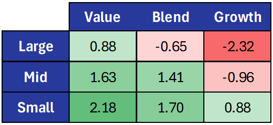
Large-cap growth extended its downward momentum last week, as heavy tech selling on Thursday drove the NASDAQ 2.6% lower, its largest daily decline since June. The setback followed a 4.5% decline the prior week, leaving the index about 6.0% below the record high set two and a half weeks earlier. On the opposite side of the style box, small-cap value led U.S. equities.
Week in review
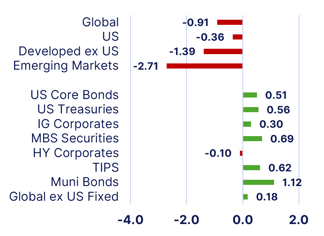
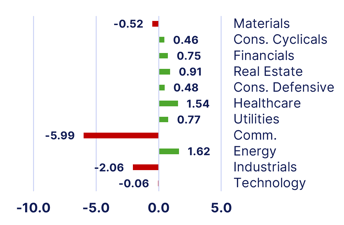
Stocks finished modestly lower last week in a relatively quiet macro calendar as investors digested the first few mega-cap tech earnings reports and further deterioration in the housing market. Stocks opened the week higher on Monday in a narrow, tech-led rally, despite the NAHB Housing Market index sinking to 29, its weakest reading since June 2012. Builder confidence has continued to decline amid higher mortgage rates with 43% of builders cutting prices. Stocks extended their gains on Tuesday supported by a decline in oil prices and Treasury yields, despite housing starts falling 5.2% and pending home sales falling to their lowest level since the series began in 2001. Strong tech results overnight supported stocks on Wednesday, but the tone shifted meaningfully on Thursday, as another rise in oil prices sparked growth concerns despite jobless claims falling to 194k. Friday closed marginally lower, as a softer services PMI was offset by a manufacturing activity PMI at its strongest level since May 2022, while the final University of Michigan Consumer Sentiment reading was revised up to 48.0 despite higher inflation expectations.
Spotlight
Markets head into this week’s Federal Open Market Committee (FOMC) meeting with little suspense around the decision, as futures markets were pricing in a 90.6% chance of an interest rate hold as of Friday. The real focus will be on how the Fed frames the path forward, and whether it still sees room for the second and final hike that Chair Kevin Warsh hinted at for their December meeting. Since the start of the US-Iran War, oil prices and 10-year Treasury yields have largely moved in lockstep. Last week, that relationship broke down. Front-month Brent crude rose to near its wartime highs, yet 10-year Treasury yields dipped below 5% for the first time since the Fed hiked in September. Earlier this year, rising oil prices fueled inflation fears. Today, it appears to be fueling growth fears instead. With higher-for-longer oil rarely a tailwind for growth, bond markets may be signaling that further hikes risk leaving the Fed on the wrong side of the economy, tightening into a slowdown at precisely the wrong time.
Markets
Sectors
Style & Market Cap
Sources
1. Home Builder Sentiment
National Association of Home Builders (NAHB), Builder Sentiment Falls on Rising Rates, retrieved from NAHB, https://www.nahb.org/news-and-economics/press-releases/2026/10/builder-sentiment-falls-on-rising-rates
2. Housing Starts & Building Permits
United States Census Bureau, Monthly New Residential Construction, retrieved from U.S. Census, https://www.census.gov/construction/nrc/current/index.html
3. Pending Home Sales
National Association of REALTORS (NAR), Pending Home Sales, retrieved from NAR; https://www.nar.realtor/research-and-statistics/housing-statistics/pending-home-sales
4. Jobless Claims
U.S. Department of Labor, Unemployment Insurance Weekly Claims, retrieved from U.S. Department of Labor; https://www.dol.gov/ui/data.pdf
5. S&P Global Services and Manufacturing Surveys
S&P Global, S&P Global US Services and Manufacturing PMIs, retrieved from S&P Global, https://www.pmi.spglobal.com/Public/Release/PressReleases
6. Consumer Sentiment
Surveys of Consumers, University of Michigan Consumer Sentiment Index Summary, retrieved from University of Michigan, https://www.sca.isr.umich.edu/
Market Data
Morningstar Direct using Morningstar Indices
Author:

Anthony Silva
CFA®
Senior Director, Strategy Management
World Investment Advisors, LLC